

Choosing the Right Payment Integration Partner
Payments look simple from the outside. A customer taps, swipes, or clicks, and money moves. The reality underneath is anything but simple, and the partner you choose to navigate it will quietly determine whether your product ships on time, passes certification, and scales without breaking.
If you are evaluating development partners to help you integrate payments, the most expensive mistake you can make is treating payments like any other software discipline. It is not. And the right partner is one that already lives inside its complexity.
Why a Payments-First Partner Matters
There is no shortage of capable software shops. Many will quote attractive rates and point to impressive portfolios full of mobile apps, dashboards, and SaaS products. That work is genuinely impressive. It is also rarely a predictor of success in payments.
Payments sit at the intersection of hardware, firmware, cryptography, network protocols, processor specifications, scheme rules, and regulatory frameworks that change constantly. A team that has never sat across the table from a certifying body, or never debugged a failed L3 script at 2am the night before a submission deadline, will learn those lessons on your timeline and on your budget.
The seduction is real. Lower hourly rates. Aggressive timelines. Confident pitch decks. What gets glossed over is the cost of ramp-up, the cost of failed certification attempts, and the cost of architecture decisions made by people who do not yet know what they do not know.
The Complexity Most Teams Underestimate
Card Present
Card present integrations are deceptively physical. You are not just writing software. You are coordinating across:
→ EMV kernels and contact and contactless flows for Visa, Mastercard, American Express, Discover, Interac, and regional schemes
→ L1, L2, and L3 certifications, each with their own labs, test plans, and processor-specific scripts
→ Terminal hardware from PAX, Ingenico, Clover, ID TECH, and others, each with their own SDKs and quirks
→ PCI PTS, PCI DSS, and P2PE considerations that touch firmware, key injection, and physical handling
→ Processor host specifications that change without much notice and require regression testing across every supported terminal
A single misread tag in a TLV stream, or a misconfigured CVM list, and your certification submission comes back with findings. Each round trip with the lab and processor can cost weeks.
Card Not Present
Card not present looks easier on the surface, and that is exactly where teams get hurt.
→ Tokenization, network tokens, and account updater services that quietly determine your authorization rates
→ 3DS 2.x flows, frictionless versus challenge, and the device fingerprinting data your gateway expects
→ PCI scope reduction through hosted fields, iframes, and SAQ-A versus SAQ-A-EP boundaries that most developers cross without realizing
→ Recurring billing logic, dunning, MIT versus CIT indicators, and the mandate frameworks that govern them
→ Chargeback representment data, fraud signals, and the orchestration layer that makes the difference between a healthy MID and a frozen one
None of this shows up in a developer's first sprint. All of it shows up in the first audit, the first dispute, or the first month when authorization rates quietly dip and nobody can explain why.
How Mojave Augments Your Team
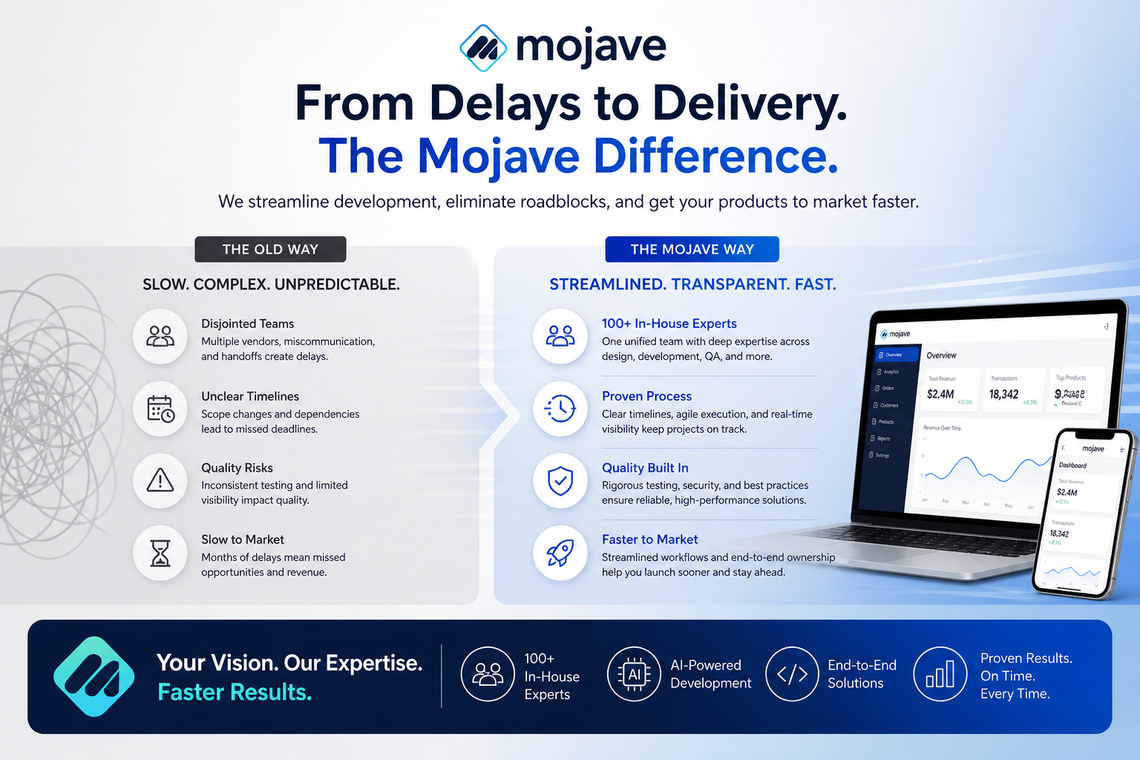
Mojave is not a replacement for your engineering organization. We are an extension of it. Our 100+ person team of developers, designers, QA engineers, and project managers plugs into your existing infrastructure, your existing repos, your existing standups, and adds the payments-specific muscle that is hard to hire and harder to retain.
We have spent more than three decades in this industry. We have completed over 130 EMV L3 certifications across the US, Canada, Europe, LATAM, and the Caribbean. We have working relationships with the labs, the processors, and the terminal manufacturers that turn weeks of email tag into a fifteen-minute call.
Most importantly, we deliver value immediately. Not after a six-week ramp. Not after we hire and train a payments practice. Immediately, because we have already done the work many times over.
What That Looks Like in Practice
Cutting Certification From 16 Months to 7
One client came to us mid-project. They had been working toward an EMV L3 certification for over a year, and the finish line kept moving. The issue was not effort. It was the absence of a few specific competencies and a few specific relationships.
We brought in a tightly assembled team with every prerequisite already in place. EMV kernel expertise, processor-specific script knowledge, terminal SDK fluency, and direct working relationships with the certification lab and the acquirer. The path that had taken sixteen months to half-finish, we completed in seven.
The timeline was not the only win. By compressing the schedule and removing the rework, the client also spent less than they would have continuing on the original trajectory. Faster and cheaper, in a category where those two words rarely belong in the same sentence.
Six Months to Replace What Years Could Not
Another client carried the kind of technical debt that quietly bleeds an organization. Critical pieces of legacy code that no longer talked cleanly to the rest of the stack. Workarounds layered on workarounds. Two full-time engineers committed almost entirely to keeping the lights on, with little capacity left to build anything new.
Our team came in, mapped the architecture, and rebuilt it as a modular, leaner codebase. Portable across the multiple platforms the client operated. Documented. Testable. Maintainable by a single engineer with time left over.
What the client had attempted, in pieces, over several years, Mojave delivered in six months. The two full-time resources were freed to work on revenue-generating features. The new architecture has scaled cleanly across every platform it has been deployed to since.
A Few Things to Look For
When you are evaluating a payment integration partner, the questions that separate the contenders from the pretenders are not about hourly rates. They are:
→ How many EMV certifications has your team completed, and on which processors and terminal families?
→ Can you walk me through a recent certification that did not go smoothly, and how you recovered?
→ Which labs and acquirers do you have direct working relationships with?
→ How do you handle PCI scope, and what is your stance on SAQ boundaries?
→ Who owns the integration after we go live, and what does long-term support look like?
Answers should come quickly, specifically, and with names attached. If they do not, keep looking.
Who We Are
Mojave Technologies is a Las Vegas-based payment technology and software development company with offices across the United States and Europe. We specialize in EMV L3 certification, Android payment app development, SoftPOS, unattended payments, PCI compliance, and AI-driven solutions. Our portfolio includes Honeybee Kiosk, Landed.net, Puny.io, Rhumba.ai, MDB Pay Connect, and Pulse Pay Connect.
Whether you need to augment a team, accelerate a certification, modernize a legacy stack, or build something new from the ground up, we would welcome the conversation.
→ Book a meeting: meet.mojave.co
→ Contact us: mojave.co/contact-us
→ Learn more about our custom development services: mojave.co/custom-development