

It usually starts with a notification you don't want to read. A customer reports a fraudulent charge after shopping with you. Your payment processor flags a spike in chargebacks. Google quietly demotes your site, or worse, slaps a red "deceptive site ahead" warning across your homepage. Somewhere between coffee and your first meeting, you realize the unthinkable: your store has been compromised.
If that's where you are right now — take a breath. You're not the first, you won't be the last, and there's a clear path forward. This guide is for the small and mid-sized e-commerce owner who just learned their website is no longer entirely their own.
⚠ The Reality: This Is Far More Common Than You Think
Small business owners often assume attackers only chase Fortune 500 logos. The data tells a very different story. Industry research from 2025 paints a sobering picture:
→ 46% of small businesses experienced a cyberattack in 2025, with attempts occurring roughly every 11 seconds.
→ The average breach cost for a small business is around $120,000, with some estimates ranging up to $1.24 million when downstream impact is factored in.
→ 60% of small companies that suffer a serious cyberattack close their doors within six months.
→ 55% of U.S. consumers say they would be less likely to do business with a company that has been breached.
→ 29% of small businesses that suffer a data breach permanently lose customers due to broken trust.
→ Detection is painfully slow — organizations take an average of 194 days to identify a breach, and another 73 days to contain it.
For e-commerce specifically, the numbers get sharper. Web application breaches account for roughly a quarter of all breaches across every industry, and formjacking (malicious code skimming payment forms) is now responsible for nearly three-quarters of web-related data breaches — half of those hitting retail.
The financial damage is only half the story. The other half is reputation, and reputation does not have an "undo" button.
✕ How Did This Happen? The Most Common Compromise Scenarios
To respond effectively, you first need to understand what likely happened. Compromises of e-commerce websites generally fall into a handful of well-known patterns.
1. SQL Injection (SQLi)
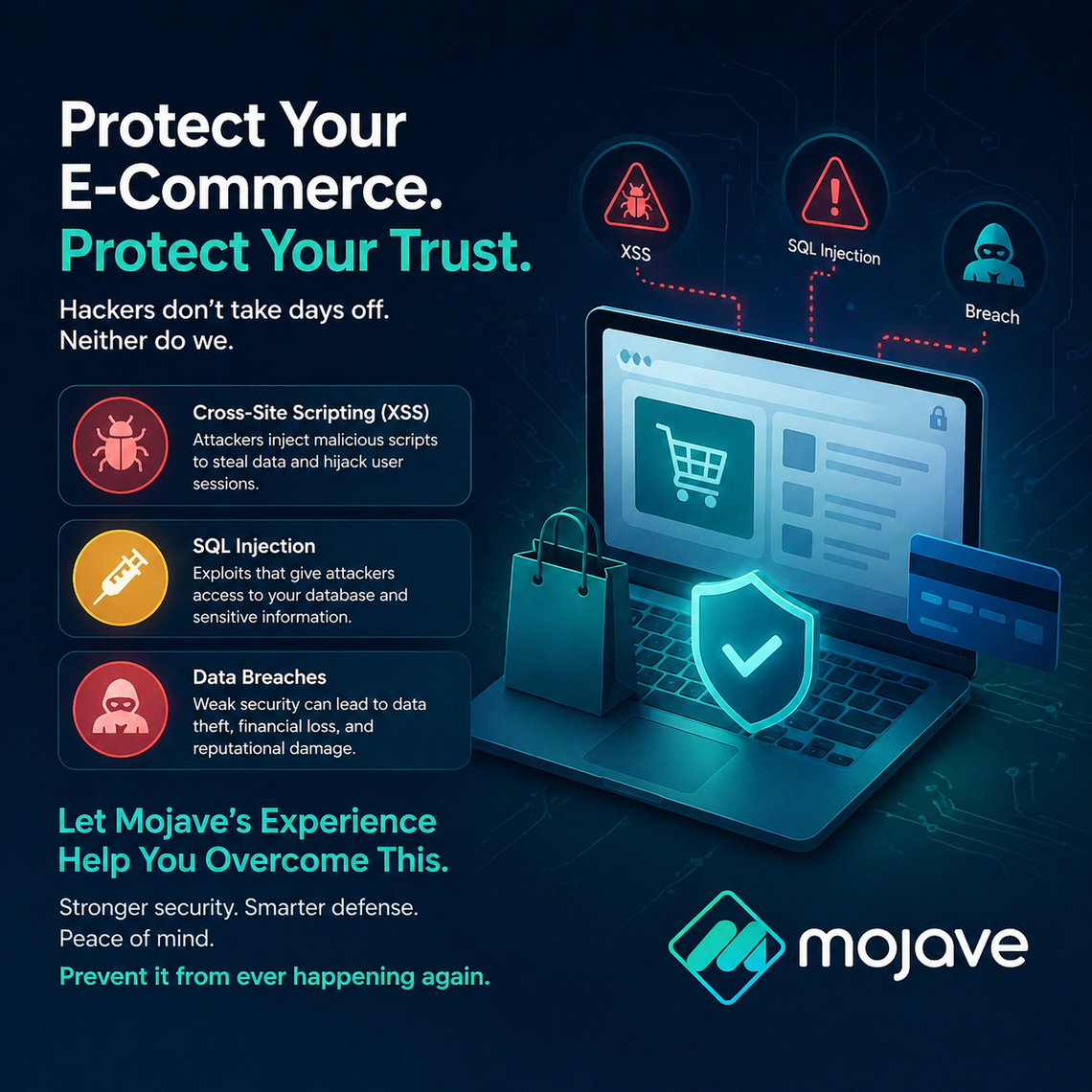
An attacker submits crafted input — often through a search box, login form, or URL parameter — that tricks your database into executing commands it shouldn't. The result can range from leaked customer records to full administrative takeover. SQL injection has been responsible for an estimated 20% of data breaches in recent years, and remains a top-three risk on the OWASP Top 10. It's "low frequency, high impact" — when it works, it tends to work catastrophically.
2. Cross-Site Scripting (XSS)
XSS lets attackers inject malicious JavaScript that runs inside your customers' browsers when they visit your site. There are three flavors — reflected, stored, and DOM-based — and all of them can lead to session hijacking, credential theft, defacement, or silent redirection to a phishing page. XSS accounts for roughly 15% of web application attacks and has generated more than 30,000 published CVEs, making it the single most frequently occurring injection class.
3. Magecart and Digital Skimming (Formjacking)
This is the e-commerce nightmare scenario. Attackers inject obfuscated JavaScript into your checkout page — sometimes directly, sometimes through a compromised third-party script (analytics, chat widget, marketing pixel). The script silently copies every credit card number, CVV, and billing detail your customers enter and ships them off to an attacker-controlled server. The site continues to function perfectly. The customer completes the purchase. Nobody notices for weeks or months. Famous victims include British Airways (~400,000 cards exposed) and Hanna Andersson, which paid $400,000 to settle a CCPA-related lawsuit after a similar incident.
4. Outdated CMS, Plugins, and Themes
Magento, WooCommerce, OpenCart, PrestaShop, Shopware — all powerful, all regularly patched, and all routinely exploited when owners fall behind on updates. In one widely reported campaign, attackers compromised 500+ Magento stores in roughly 24 hours by chaining a vulnerable plugin with SQL injection and PHP Object Injection — and planted up to 19 backdoors per site to ensure persistence even after cleanup.
5. Stolen, Weak, or Reused Credentials
Roughly 81% of confirmed breaches involve weak, reused, or stolen passwords. An admin account without multi-factor authentication, a developer reusing a password that leaked elsewhere, or a phished employee is often all it takes. No exotic exploit required.
6. Supply Chain & Third-Party Compromise
Modern e-commerce sites pull in dozens of third-party scripts: analytics, A/B testing, live chat, payment widgets, shipping calculators. 60% of breaches now originate from a third-party vendor. If one of those providers gets compromised, every site loading their script can be compromised at the same time.
7. Misconfigured Hosting & Cloud Infrastructure
Sometimes the application itself is fine — the environment is the problem. Open S3 buckets, exposed admin panels, default credentials on databases, overly permissive IAM roles, missing WAF rules, unsegmented networks. 42% of small businesses store sensitive customer data on cloud platforms without encryption. Misconfiguration alone accounted for 30% of "miscellaneous error" breaches in 2025.
◆ Two Scenarios Worth Studying
Scenario A — The Application Was Compromised
You run a Shopify, WooCommerce, or custom-built storefront. An outdated plugin, an un-sanitized input field, or a Magecart-style script injected through a third-party tag becomes the entry point. The attacker now has a foothold inside your application — they can read your database, harvest payment data at the point of entry, create hidden admin accounts, and plant backdoors that survive cleanup attempts. Patching the original vulnerability is necessary but rarely sufficient; the attacker has likely already laid down redundancy.
Scenario B — The Hosting Environment Was Compromised
Your code is well-written, but your infrastructure isn't hardened. Maybe SSH is exposed to the world with password authentication enabled. Maybe your database accepts connections from any IP. Maybe a developer left an .env file in a public S3 bucket. Maybe your control panel uses a four-year-old admin password. The attacker doesn't need to defeat your application — they walk in through the front door of the server itself, then modify your application files at will. This kind of compromise is particularly insidious because the application source code in your repository looks pristine. It's only the deployed copy that has been altered.
Most real-world breaches are some combination of the two. That's why effective remediation has to look at the application and the environment together.
✓ What To Do Right Now (The First 72 Hours)
If you suspect or have confirmed a breach, sequence matters:
→ Don't panic-wipe. Preserving forensic evidence often determines whether you can identify the attacker, the entry point, and the data exposed.
→ Isolate, don't destroy. Take affected systems offline or place them behind a maintenance page while preserving logs, file timestamps, and database state.
→ Notify your payment processor and acquiring bank immediately if cardholder data may be involved. PCI DSS notification timelines are short and unforgiving.
→ Engage qualified incident response. This is not the moment for a junior developer with good intentions.
→ Rotate every credential — admin accounts, API keys, database passwords, SSH keys, third-party integration tokens.
→ Audit every third-party script loading on your checkout flow. If you can't justify it, remove it.
→ Plan your customer communication with legal counsel before you send anything. Most U.S. states have mandatory breach notification laws with specific timing and content requirements.
★ Where Mojave Comes In
At Mojave Technologies, security isn't a side practice — it's woven into how we build, deploy, and certify payment systems for clients across the U.S., Canada, Latin America, Europe, and the Caribbean. We've spent years on both sides of the table: building the systems that process payments, and validating that the systems processing payments are actually safe.
Our security practice covers the full lifecycle:
→ System & Infrastructure Hardening — locking down servers, networks, cloud environments, and CI/CD pipelines against the configuration mistakes that account for the bulk of real-world breaches.
→ Deep Application Security Reviews — manual and automated review of source code, dependencies, third-party integrations, and runtime behavior to find vulnerabilities before attackers do.
→ Defect Remediation — not just identifying issues, but fixing them properly, with verifiable regression coverage and clear documentation of what changed and why.
→ Penetration Testing — adversarial testing of your applications and infrastructure that mirrors how real attackers operate. Learn more at mojave.co/penetration-testing.
→ Team Training — bringing your developers, operations staff, and product managers up to current best practices on secure coding, secrets management, dependency hygiene, and incident response.
→ PCI DSS Compliance & Validation — we have successfully assisted with countless PCI certifications and validations, and we work hand-in-hand with all of the major Qualified Security Assessors (QSAs) and security firms in the payments ecosystem. Details at mojave.co/security-pci-compliance.
Whether you need help recovering from an active incident, validating that your environment is genuinely secure before your next QSA assessment, or building a remediation roadmap that satisfies your acquirer — we've done it before, and we can help you do it now.
◇ Free Initial Consultation
We offer a 100% free initial consultation to every small and mid-sized business owner who reaches out. No commitment, no pressure — just an honest conversation about where you stand, what your real risk exposure looks like, and what a sensible next step would be.
→ Visit mojave.co to learn more about our services.
→ Book a meeting directly with our team at meet.mojave.co.
The 60% statistic — six in ten breached small businesses closing within six months — is real, but it isn't inevitable. The owners who survive a compromise are almost always the ones who responded quickly, brought in experienced help, and treated the incident as the wake-up call it was meant to be. We'd rather help you get ahead of the next one than help you clean up after it.
#CyberSecurity #PCICompliance #ECommerce #SmallBusiness #PenetrationTesting #WebSecurity #DataBreach #InfoSec #PaymentSecurity #Mojave #SecureByDesign #Magecart #OWASP #IncidentResponse