
The Language of Payments and Protocols
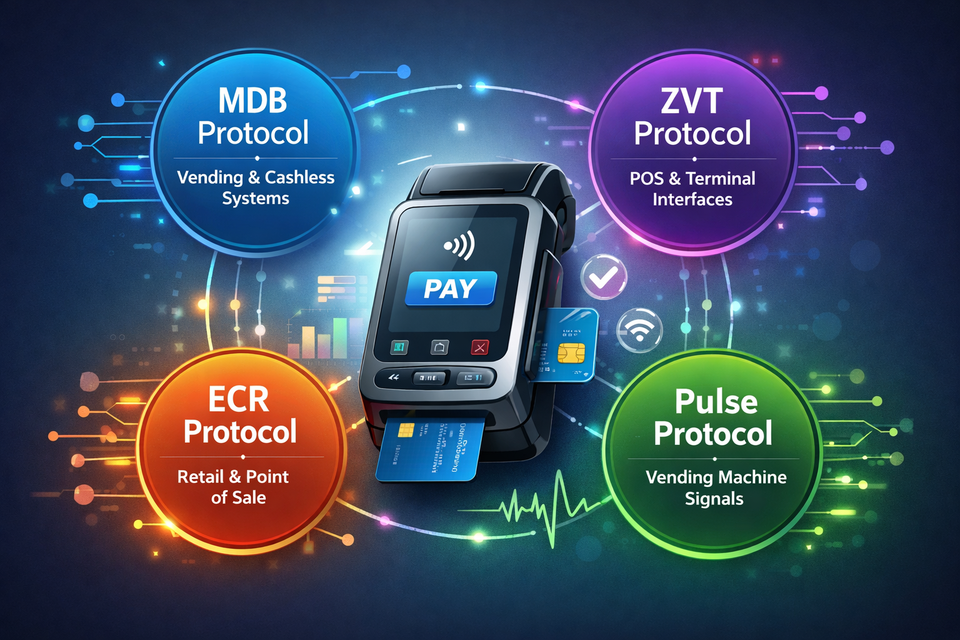
Behind every tap, swipe, and cashless transaction is a conversation — a precise, protocol-driven handshake between hardware, software, and payment networks. Understanding these protocols isn't just for engineers. It's the foundation of any serious payments integration strategy.
The Language of Payments
Payment terminals don't speak English. They speak in protocols — structured sets of rules that govern how data moves between devices, software layers, and payment networks. When a customer inserts a card, initiates a contactless tap, or feeds coins into a vending machine, a precisely orchestrated sequence of protocol-level messages fires in the background, often in milliseconds.
Modern payment ecosystems are rarely monolithic. A single deployment might involve a POS application talking to a payment terminal via one protocol, while that terminal communicates upstream to an acquirer via another, and a vending controller speaks to a cashless reader via yet another. Getting these layers to interoperate cleanly — especially across legacy hardware and enterprise systems — is where deep protocol knowledge earns its value.
Let's walk through four of the most important protocols in use today and how they connect to modern payment flows.
💳 MDB — Multi-Drop Bus
The Multi-Drop Bus (MDB) protocol was developed specifically for unattended retail — vending machines, kiosks, and self-service terminals. It defines how peripheral devices (coin mechanisms, bill validators, cashless readers) communicate with the vending machine controller (VMC) over a simple, low-voltage serial bus.
MDB is a master/peripheral architecture. The VMC acts as master, polling devices on the bus in sequence and issuing commands — request funds, dispense, reset, and more. Cashless payment devices respond in kind, signaling when a session is active, reporting approved or declined transactions, and vending enabling only when authorization is confirmed.
Despite being decades old, MDB remains the dominant standard in unattended environments globally. Its simplicity and hardware-level reliability make it the default language of vending, laundry, parking, and EV charging cashless readers.
Mojave's MDB platform runs natively on both Datacap and PAX hardware, giving operators a proven, production-ready cashless reader solution that speaks fluent MDB from day one.
🇩🇪 ZVT — The German Payment Protocol Standard
ZVT (Zahlungsverkehrsterminal) is the dominant payment terminal protocol across Germany, Austria, and Switzerland — the DACH market — and sees significant usage across broader European payment infrastructure. It defines the communication interface between an Electronic Cash Register (ECR) and a payment terminal, covering transaction initiation, authorization, receipt data, and end-of-day settlement.
ZVT operates as a bidirectional command-response protocol over serial, TCP/IP, or USB connections. A cashier system sends a payment command; the terminal processes the card interaction and returns a structured result object containing approval codes, card data masks, and receipt content. ZVT's strength is its rich feature set — it handles chip-and-PIN, contactless, partial authorization, tip handling, and multi-currency flows with precision.
For payments companies expanding into European markets or supporting multinational enterprise clients, ZVT fluency is non-negotiable. Mojave's team has direct experience working within ZVT transaction flows, enabling integrations that meet the strict certification requirements of the DACH acquiring ecosystem.
⚡ Pulse — Real-Time Payment Connectivity
Pulse is a payment network and protocol framework built for real-time debit transaction routing, enabling PIN debit acceptance across a broad merchant and ATM network. In the context of terminal integration, Pulse defines how transactions flow from point-of-interaction through debit network rails — ensuring fast, secure authorization and settlement for PIN-based payments.
In modern deployments, Pulse connectivity is especially relevant for unattended and self-service applications where real-time fund confirmation is essential — fuel dispensers, transit fare systems, and high-throughput retail kiosks. Its routing rules and network message formats must be implemented precisely to maintain compliance and approval rate performance.
Mojave has built a proprietary Pulse-connected platform on Datacap and PAX hardware, providing a certified, field-tested path to Pulse network acceptance without the typical integration overhead.
🖥️ ECR — Electronic Cash Register Protocol
ECR (Electronic Cash Register) protocols govern the communication layer between point-of-sale software and payment terminals. Rather than a single universal standard, ECR covers a family of integration approaches — including vendor-specific implementations from terminal manufacturers and payment platforms like Datacap, EFTPOS, and others — that define how a register initiates a sale, passes transaction amounts, and receives approved or declined results.
In practice, ECR integration is where the majority of POS-to-terminal friction occurs. Subtle differences in message formatting, timing, error handling, and settlement reconciliation between ECR implementations can introduce bugs that only surface in edge cases — partial approvals, network timeouts, offline fallback scenarios. Mastery of ECR protocols means building integrations that handle these gracefully, not just in ideal conditions.
Mojave's engineering team has worked at the ECR layer across multiple terminal families and POS platforms, with the low-level understanding required to adapt to existing transaction flows without disrupting the systems already running around them.
🔧 Why Protocol Depth Matters
Most payment integrations fail not because the core transaction doesn't work — but because the edge cases weren't anticipated. What happens when the terminal drops connection mid-auth? When the VMC issues an out-of-sequence command? When a legacy ECR sends a non-standard message format that the spec technically allows but nobody implements?
These are the questions that separate a surface-level integration from a production-grade one. The teams who can answer them are the ones who have read the specs in full, built to them, tested against real hardware, and shipped into real environments.
🇺🇸 Mojave's Protocol Expertise
At Mojave Technologies, protocols are not an afterthought — they're a core competency. Our team has deep, lower-level experience across MDB, Pulse, ZVT, ECR, and the surrounding payment certification landscape. We understand how these protocols behave in production, how they interact with terminal firmware, and how to integrate into existing transaction flows without disrupting the systems already in operation.
✅ We have developed our own proprietary platforms for MDB and Pulse connectivity on both Datacap and PAX hardware — production-ready solutions for unattended and retail payment environments.
✅ Our team holds the technical knowledge to work within certified transaction flows, ensuring integrations meet the requirements of acquirers, networks, and terminal manufacturers alike.
✅ Whether you're connecting a legacy kiosk fleet, building a new self-service deployment, or integrating payment acceptance into an enterprise platform, we can meet you at the protocol layer and build upward from there.
We don't build wrappers around payment APIs and call it done. We work at the level where the real complexity lives — and we've done it enough times to do it right.
That experience spans a wide range of industries and deployment environments. Mojave has successfully delivered protocol-level payment integrations across EV charging networks, vending and micro-market operators, amusement and gaming venues, car wash systems, supermarket and grocery chains, unattended parking facilities, and a variety of other unattended and self-service verticals. Each of these industries carries its own hardware constraints, transaction flow quirks, and certification requirements — and we've navigated all of them.
🤝 Let's Talk About Your Integration
If you're working on a payment integration that involves any of these protocols — or if you're inheriting a legacy system that needs to speak to modern payment infrastructure — we'd love to hear what you're building.
📅 Schedule a meeting with the Mojave team at meet.mojave.co
Bring your architecture diagram, your spec sheet, or just your questions. We'll figure out where the complexity lives and what it takes to solve it.
Mojave Technologies is a payment technology company headquartered in Las Vegas, Nevada, with offices in New Jersey, Florida, and Europe. We specialize in EMV certification, protocol integration, unattended payments, SoftPOS, and AI-powered commerce platforms. Learn more at mojave.co.


Member discussion