
EMV Level 3 Certification: Technical Insights and Streamlined Testing Solutions

EMV Level 3 certification is the final and most comprehensive testing phase that validates payment terminals for real-world transaction processing. While essential for market deployment, the certification process has traditionally been complex, time-consuming, and resource-intensive. Understanding the technical requirements and leveraging modern testing solutions can dramatically reduce both timelines and costs while ensuring compliance across global markets.
Understanding EMV Level 3 Certification
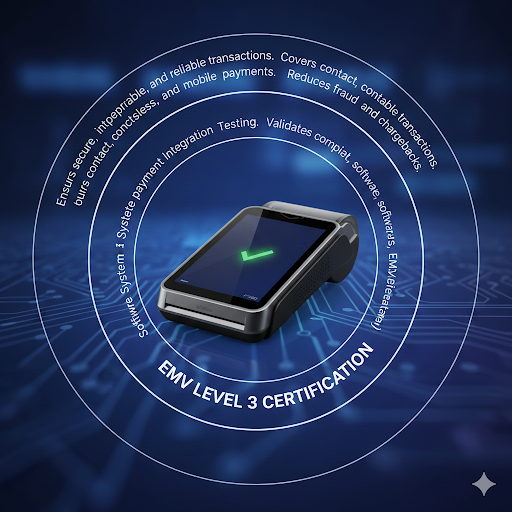
EMV Level 3 certification, also known as brand certification or end-to-end certification, validates that payment terminals can successfully process transactions within the complete payment ecosystem. Unlike Level 1 (physical and electrical testing) and Level 2 (payment application functionality), Level 3 testing ensures terminals work seamlessly with acquirer processors, payment networks, and issuing banks.
What Level 3 Testing Validates
The certification process verifies several critical aspects of terminal operation:
- Proper transaction message construction and formatting for authorization, financial, and reversal messages
- Correct implementation of card brand specifications including Visa, Mastercard, American Express, and Discover requirements
- Accurate processing of chip card data elements and cryptographic operations
- Proper handling of contactless transactions including EMV contactless and mobile wallets
- Compliance with regional requirements across different markets and payment networks
- Batch settlement procedures and reconciliation processes
- Exception handling for declined transactions, partial approvals, and communication failures
The Testing Scope
Level 3 certification encompasses hundreds of individual test cases across multiple payment scenarios. Each card brand maintains specific test requirements, and regional variations add additional complexity. Tests cover contact chip transactions, contactless payments, magnetic stripe fallback scenarios, online PIN verification, offline data authentication, and various exception conditions that terminals must handle correctly.
Technical Challenges in EMV Level 3 Certification
Multi-Party Coordination
Traditional certification projects involve coordinating multiple stakeholders including terminal manufacturers, payment application developers, acquirer processors, certification labs, and card brand representatives. Each party operates on different timelines with varying priorities, creating scheduling bottlenecks and communication delays.
Test Environment Complexity
Proper testing requires sophisticated test environments that simulate real payment networks. This includes test host systems, card simulators, network connections, and monitoring tools. Building and maintaining these environments demands specialized expertise and represents significant capital investment for most organizations.
Regional Variations
Payment requirements vary significantly across geographic regions. What passes certification in the United States may require different configurations for European markets or Latin American deployments. Managing these variations while maintaining code consistency creates technical challenges for development teams.
Evolving Standards
Card brands continuously update their specifications to address new security threats, support emerging payment methods, and improve transaction efficiency. Staying current with these changes while managing certification projects requires constant attention to technical updates and specification changes.
The Traditional Certification Process
User Acceptance Testing (UAT)
Development teams create test scripts covering thousands of transaction scenarios. Each scenario must be executed, documented, and validated against expected results. This phase typically requires 4-8 weeks of intensive testing and can consume significant engineering resources.
Host Validation Testing
The terminal's ability to communicate with acquirer host systems is validated. This includes message formatting, field population, cryptographic key management, and batch processing. Issues discovered during this phase often require code changes and retesting, extending timelines by several weeks.
Pre-Certification Testing
Before formal certification begins, comprehensive testing ensures the terminal, middleware, and host systems work together correctly. This phase identifies and resolves issues that would cause certification failures, but requires access to specialized testing tools and environments.
Formal Level 3 Certification
The final certification involves executing the complete test suite under observation by certification specialists. Any failures require root cause analysis, fixes, and retesting. The formal certification process alone can take 6-12 weeks, with additional time required for any remediation.
Traditional certification timelines range from 6 months to 2 years depending on project complexity, terminal capabilities, number of supported card brands, and geographic scope. Organizations often spend $100,000 to $500,000 or more on certification projects when accounting for engineering time, testing infrastructure, and specialist fees.
Modern Solutions: The No-Code Certification Approach
Recent advances in testing automation and platform-based certification have transformed the EMV Level 3 process. No-code certification platforms eliminate the need for extensive custom test script development and provide pre-configured test environments that handle the technical complexity of certification testing.
How No-Code Platforms Work
Instead of building custom test infrastructure, organizations leverage platforms that provide:
- Pre-configured test cases aligned with current card brand specifications
- Automated test execution that eliminates manual testing errors
- Real-time validation and error reporting for immediate issue identification
- Cloud-based test environments that eliminate infrastructure investment
- Integrated tools for all certification phases from UAT through formal testing
This approach allows engineering teams to focus on building robust payment applications while certification specialists handle the testing complexity. The platform manages test case execution, result documentation, and compliance validation automatically.
Key Advantages
Organizations using no-code certification platforms report several benefits. Timeline reductions of 50-70% are common as automated testing eliminates manual test execution and scheduling delays. Cost savings of 40-60% result from reduced engineering time, elimination of infrastructure investment, and faster time to market. Error rates decrease significantly as automated validation catches issues immediately rather than during expensive certification sessions.
Mojave Technologies: Proven Certification Excellence
Industry-Leading Track Record
130+ EMV Level 3 Certifications Completed
30 Years Payment Industry Experience
97% First-Time Certification Success Rate
Mojave Technologies has completed over 130 EMV Level 3 certifications across the United States, Canada, Europe, the Caribbean, and Latin America. With nearly 30 years of payment industry experience, Mojave understands the technical nuances of certification across different markets and payment networks.
The Mojave Advantage
Mojave's no-code certification platform represents a fundamental shift in how organizations approach EMV testing. Rather than coordinating multiple vendors and building custom testing infrastructure, clients work with a single partner who handles the entire certification lifecycle.
The platform includes pre-configured test cases for all major card brands, automated test execution that eliminates manual errors, and real-time validation that identifies issues immediately. Mojave's team of certification specialists guides projects from initial planning through final letter of acceptance, ensuring smooth progression through each certification phase.
What Makes Mojave Different
Unlike traditional certification approaches that require clients to manage testing tools, environments, and specialist coordination, Mojave provides a comprehensive platform solution. The company owns and licenses specialized testing tools, eliminating the need for clients to invest in expensive equipment. Cloud-based infrastructure means no hardware deployment or maintenance. Experienced certification engineers provide hands-on support throughout the process.
Most importantly, Mojave's approach allows engineering teams to focus on building great payment solutions rather than managing certification complexity. While developers concentrate on application features, terminal capabilities, and user experience, Mojave handles test execution, compliance validation, and coordination with card brand representatives.
Certification Best Practices
Whether using traditional methods or modern platforms, successful certification projects follow several key principles. Early planning prevents costly delays, so organizations should define certification scope, identify target markets, and establish timelines before development begins. Continuous testing throughout the development cycle catches issues early when they're easier and cheaper to fix. Proper documentation of test results, configuration settings, and code changes streamlines the certification process and helps with future recertification efforts.
Organizations should also consider regional requirements from the start of development. Building applications that support multiple markets from the beginning is far more efficient than retrofitting regional support later. Similarly, planning for future card brand specification updates ensures applications remain compliant as requirements evolve.
The Future of EMV Certification
As payment technology continues advancing, certification processes are evolving to support new capabilities. Contactless transaction volumes continue growing, requiring enhanced testing of NFC implementations and mobile wallet support. Biometric authentication is becoming more common, adding new test scenarios for fingerprint and facial recognition. Cloud-based POS systems and software POS solutions introduce additional testing complexity as certification extends beyond traditional hardware terminals.
Despite these changes, the fundamental goal of EMV Level 3 certification remains constant: ensuring terminals process payments securely, reliably, and in compliance with card brand requirements. Organizations that leverage modern testing platforms and experienced certification partners will navigate these evolving requirements more effectively.
Accelerate Your EMV Certification
Reduce certification timelines by up to 70% and costs by 50% with Mojave's proven no-code platform. Let your engineering team focus on building great payment solutions while Mojave handles certification complexity.
Learn More About EMV Certification
Ready to discuss your certification needs? Book a meeting with our team to explore how Mojave can accelerate your EMV Level 3 certification project.
Conclusion
EMV Level 3 certification is essential for payment terminal deployment but doesn't have to be a lengthy, expensive process. Understanding the technical requirements, common challenges, and modern testing solutions helps organizations make informed decisions about certification approaches.
With over 130 successful certifications across global markets and nearly 30 years of payment industry expertise, Mojave Technologies offers a proven path to faster, more efficient EMV Level 3 certification. The company's no-code platform eliminates traditional bottlenecks while ensuring compliance with card brand requirements across all major payment networks.
Whether you're certifying your first payment terminal or managing multiple certification projects across different markets, working with an experienced partner who provides comprehensive platform solutions can dramatically reduce both time and cost while improving certification success rates.
Member discussion