
Embedded Payments: Stop Renting Your Rails, Start Owning Your Revenue
Paying.co builds the rails. You build the company.
Every SaaS platform, vertical software vendor, marketplace, and ISV eventually arrives at the same realization: payments are no longer a feature, they are the business. The companies that figured this out early are now collecting two, three, sometimes four times more revenue per customer than the ones still passing transactions through to a third-party processor and collecting a referral check.
The shift has a name. Embedded payments. And it is the single biggest revenue lever available to software companies right now.
What Embedded Payments Actually Means
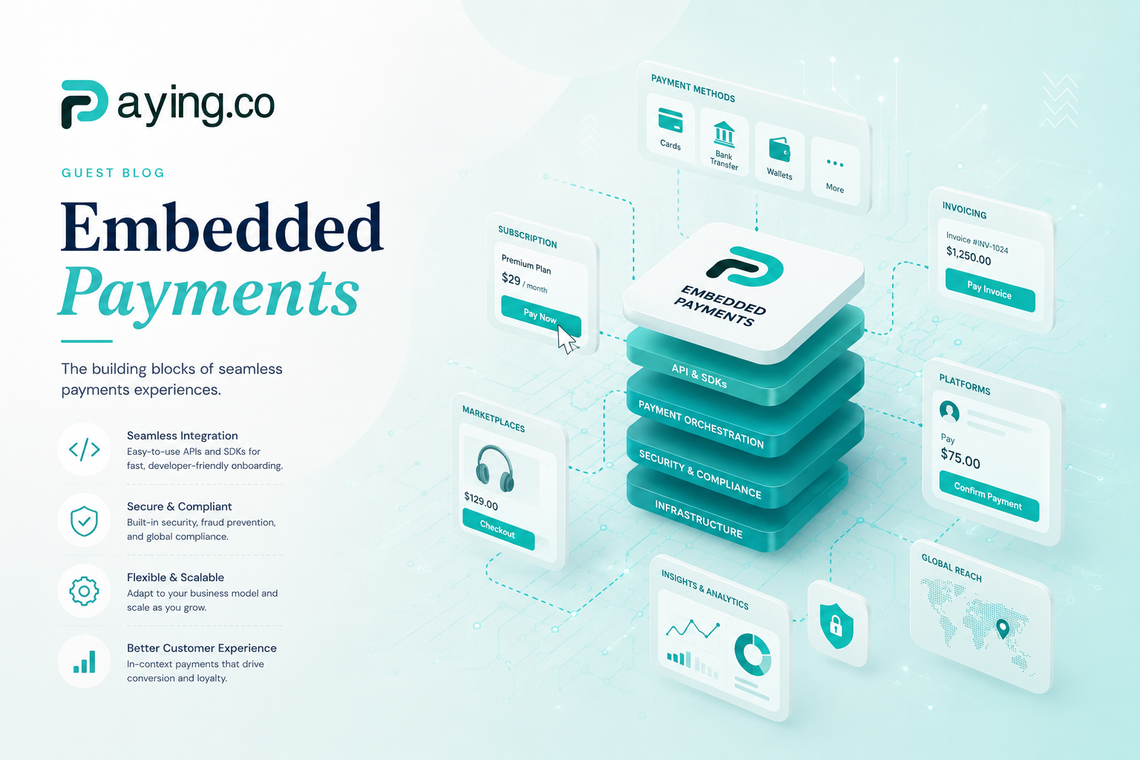
Embedded payments is the practice of bringing payment acceptance directly inside your product, under your brand, on your terms, instead of bouncing your users out to a third-party processor and earning a thin partner commission.
At its simplest, it is a co-branded experience with revenue share. At its most mature, it is a full payment facilitator model where you own the merchant relationship, set the rates, control the underwriting, and capture the spread between interchange and what your merchants pay.
Between those two endpoints sits a spectrum:
→ Referral partnerships, where you send leads and collect a small share
→ Integrated payments, where your software talks directly to a gateway under a revenue share
→ Payfac-as-a-Service, where a sponsor bank and a platform partner handle compliance while you own the merchant experience
→ Full payment facilitator, where you carry the BIN, the risk, and the upside
Each step up the ladder unlocks more revenue, more control, and more responsibility. Knowing where your business should sit is half the conversation. Building the rails to get you there is the other half.
Why This Is The Right Conversation In 2026
A few forces are converging that make this the right moment for almost every vertical SaaS platform to take embedded payments seriously.
The first is unit economics. A vertical SaaS company charging fifty dollars a month per seat can comfortably layer another one hundred fifty dollars a month per customer in payments revenue once the rails are in place. That is not a hypothesis. That is the operating reality of every successful vertical software platform built in the last decade.
The second is customer expectation. Merchants no longer want to stitch together five vendors. They want to log into one product and have everything work. The platforms that own the payment experience own the customer.
The third is the maturity of the infrastructure itself. Sponsor banks, BIN sponsorships, processor APIs, KYC and KYB providers, dispute orchestration platforms, and tokenization vaults are all available as composable pieces. The question is no longer whether you can build it. The question is whether you have the team that knows how.
What Most Teams Underestimate
Embedded payments looks like a software project. It is not. It is a regulated financial product that happens to ship as software.
The pieces that catch teams off guard:
→ Underwriting and onboarding flows that satisfy KYC, KYB, OFAC, and sanctions screening across every market you operate in
→ Tokenization architecture that keeps PCI scope contained to a SAQ-A or SAQ-D footprint that your business can actually defend
→ Funding logic, settlement timing, reserve policy, and reconciliation against processor batches that arrive on someone else's schedule
→ Dispute and chargeback orchestration with representment evidence that wins, not just files
→ Sub-merchant monitoring, velocity rules, and fraud signals tuned to your vertical, not a generic SaaS template
→ 1099-K reporting, state money transmitter considerations, and the patchwork of regional rules that govern who can hold funds and for how long
→ Network tokens, account updater, and the quiet authorization rate optimizations that determine whether your platform feels reliable or flaky
None of this shows up in the first sprint. All of it shows up in the first audit, the first scaled month, or the first time a sponsor bank asks for evidence of controls.
The Geography Problem Nobody Solves Cleanly
If your platform operates in more than one country, embedded payments stops being a project and starts being a portfolio of projects. Every region has its own rails, its own schemes, its own regulators, and its own merchant expectations.
Paying.co has spent more than three decades building payment infrastructure across exactly the geographies that matter for North American and global software companies looking to expand.
→ United States. Full payment facilitator architecture, sponsor bank relationships, processor integrations across the major acquirers, and the operational playbooks that keep sub-merchant portfolios healthy. ACH, RTP, and FedNow rails alongside card.
→ Canada. Interac flows, Canadian scheme certifications, and the regulatory nuances that distinguish a Canadian merchant boarding experience from a US one.
→ Europe. PSD2 and SCA compliance, 3DS 2.x orchestration, SEPA Direct Debit, and country-specific scheme rules that catch first-time entrants off guard.
→ Latin America. The complexity of installment plans, local schemes, Pix in Brazil, OXXO and SPEI in Mexico, and the acquirer relationships that turn a market entry from a six-quarter slog into a two-quarter launch.
→ Caribbean. Multi-currency, multi-acquirer integrations across island markets where most global processors do not operate cleanly, and where deep local knowledge is the difference between a working product and a stalled one.
→ Australia. eftpos and scheme certifications, NPP and PayTo integrations, and the AUSTRAC and APRA considerations that shape how a platform operates in market.
We have completed over 131 EMV Level 3 certifications across these regions. We have the lab relationships, the processor relationships, and the sponsor bank relationships that turn months of email tag into a fifteen-minute call. That is the difference between a roadmap that ships and one that slips.
What We Actually Build
Paying.co is a payments engineering company. Embedded payments is what we do every day. A typical engagement spans some combination of:
→ Architecture and strategy. Where on the embedded spectrum should your business sit, and what does the eighteen-month roadmap look like to get there?
→ Sponsor bank and processor selection. The right partner for a vertical SaaS in dental is not the right partner for a marketplace in logistics. We have the relationships and the data to make the right call.
→ Underwriting, boarding, and KYC and KYB flows that satisfy compliance without strangling conversion.
→ Tokenization, vaulting, and PCI scope reduction so your SAQ boundary is one your auditor and your engineering team can both live with.
→ Gateway integration, smart routing, and authorization optimization.
→ Settlement, funding, reconciliation, and the back-office logic that turns a payments product into a payments business.
→ Dispute and chargeback orchestration with representment workflows that actually win money back.
→ Reporting, 1099-K, and the merchant-facing analytics your customers will expect from day one.
→ Ongoing operations, monitoring, and the long-tail support that keeps authorization rates climbing and risk losses falling.
We can plug into your existing engineering organization as an extension of your team, or we can deliver the entire stack turnkey. Most clients land somewhere in between.
What This Frees Your Team To Do
The most underrated benefit of working with a payments engineering partner is what it lets your own team stop doing.
Your product team does not need to become payment experts. They need to ship the features your customers ask for. Your engineering team does not need to spend a year learning EMV kernel quirks or PSD2 nuances. They need to grow your platform. Your finance team does not need to build a settlement engine. They need to close the books and forecast the next quarter.
When the rails are owned by a partner who has built them a hundred times, your team is free to focus on the only thing that compounds: growing the business.
A Practical Place To Start
Embedded payments engagements do not need to begin with a multi-year contract. They begin with a thirty-minute conversation about where your platform is today and what the next obvious step looks like.
If you are an ISV, a vertical SaaS platform, a marketplace, or a software company that has been quietly leaving payment revenue on the table, we would welcome that conversation.
→ Book a meeting: meet.paying.co
→ Contact us: paying.co/contact-us
→ Email us: sales@paying.co
# EmbeddedPayments # PaymentFacilitator # PayFac # VerticalSaaS # FintechDevelopment # PaymentsPartner # ISV # SaaSPayments # EmbeddedFinance # PaymentInfrastructure # GlobalPayments # CrossBorderPayments # PaymentTechnology # PCICompliance # PaymentOrchestration # MerchantServices # PayingCo # PaymentsEngineering # SoftwareMonetization # RevenueGrowth